Six islands you can visit, two you cannot, and who each one suits
Which Hawaiian Island Should You Visit?
No island is best for everyone, and the state's own visitor site says there are no wrong answers. Pick by the trip you want, from Honolulu and Pearl Harbor to the Road to Hāna or Kīlauea, and in October 2026 by what is open: most of Kauaʻi's state parks are still closed after Hurricane Lowell.
Six Islands You Can Visit, Two You Cannot
Start With the Island, Then the Tour
Open an island to see who it suits, how you get there, what the 2026 storms changed and which tours cover it, with where each one leaves from.
Maui
Lonely Planet, Condé Nast Traveler and U.S. News all send couples here: the Road to Hāna, sunrise on Haleakalā and, from November to April, humpback whales. It costs more per day than Oʻahu, $305 a person in 2025 against $238.
Hāna, Haleakalā, whales →
MOST VISITEDOʻahu
Honolulu, Waikīkī, Pearl Harbor and the North Shore's winter surf on one island, and 5.7 million visitors in 2025, the most of any. Condé Nast Traveler's pick for a first trip.
Pearl Harbor to the North Shore →
STORM UPDATE · OCT 2026Kauaʻi
Lonely Planet's island for hiking and waterfalls, but as of early October 2026 most state parks, the Kalalau Trail and Waimea Canyon among them, are closed after Hurricane Lowell. The air tours are flying, on limited schedules.
What is running now →
THE BIGGEST ISLANDIsland of Hawaiʻi (Big Island)
Kīlauea, the Maunakea summit and the Kona manta rays, on an island larger than all the others combined. The eruption continues but has not fountained since 25 August 2026, so no tour can promise lava.
Volcano, summit, mantas →
BY FERRY FROM MAUILānaʻi
One town, two Four Seasons resorts and the highest visitor spending in the state, $629 a person per day in 2025. The ferry from Māʻalaea takes about 70 minutes, and the snorkel boats listed here leave from Maui too.
Ferry, resorts, day boats →
FLY-IN ONLYMolokaʻi
The highest share of Native Hawaiian residents of the six visitable islands, and a 2026 tourism plan that asks visitors to come prepared and respectful, with guides where access needs them. No ferry since 2016; the helicopter tours listed here fly over from Maui.
What the island asks →
PRIVATELY OWNEDNiʻihau
Owned by one family since 1864, home to 84 people in 2020, and closed to independent visits. The boat from Port Allen on Kauaʻi snorkels off Lehua without landing; it was paused after Hurricane Lowell, so check its calendar for dates.
Seeing it from the water →
NO PUBLIC ACCESSKahoʻolawe
A Navy bombing range from 1941 to 1990, returned to the State in 1994 and still not fully cleared of ordnance; only volunteer and cultural trips go ashore. You can see it from South Maui and the Lānaʻi ferry.
Its history, and who may go →
ALL EIGHT ISLANDSThe Hawaiian Islands Map
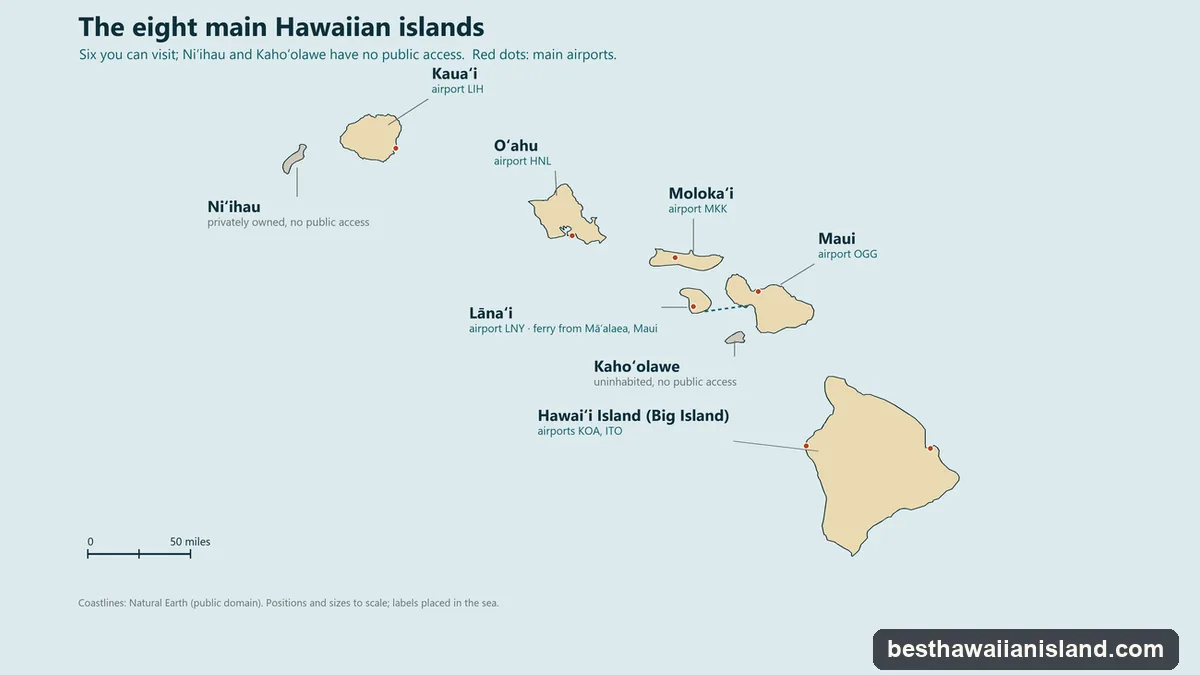
Where each of the eight sits, how big it is, the channels between them, and the flights and the one ferry that connect them.
Open the map →
The Chooser
Six Islands, Six Different Trips
Who each island suits, in the words of the guides that say so, with the state's 2025 figures and what the 2026 storms changed.
The Hawaiʻi Tourism Authority runs the state’s visitor site, and it does not rank the islands. “It won’t be easy choosing which island to visit on your first trip to Hawaiʻi,” it says, “but you’ll find there are no wrong answers.” Each island suits a different trip. In October 2026 there is a second test as well: what a heavy storm season left open.
Six of the eight main islands take visitors. Here is who each one suits, with the guide behind every pick named.
Who should go where
- A first trip: Oʻahu or Maui, and the guides split. Condé Nast Traveler and U.S. News’s 2025 ranking point to Oʻahu, an older U.S. News tips page to Maui. The state’s figures show where first-timers go: 35.4 percent of Oʻahu’s 2025 visitors were on their first trip to Hawaiʻi, against 27.3 percent of Maui’s.
- Couples: Maui, and here the three big guides agree. Lonely Planet calls it best for romance and scenic drives, Condé Nast Traveler makes it the honeymoon island, and U.S. News calls it “the best island for both couples and families looking for variety”.
- Families: Maui or Oʻahu. U.S. News says Maui; Condé Nast Traveler says Oʻahu, which “has the most” beaches with lifeguards, parking and restrooms. The families guide adds each tour’s age limits.
- Volcanoes and wide-open landscapes: Hawaiʻi Island, Condé Nast Traveler’s choice for immersive adventure and Lonely Planet’s for volcanic activity.
- Hiking and waterfalls: Kauaʻi, in Lonely Planet’s sorting, though most of its state parks have been closed since Hurricane Lowell in September.
- A tight budget: one island, says U.S. News, and “especially Oʻahu”, says Lonely Planet, for its public transit and its range of room prices.
- Quiet: Lānaʻi for luxury and seclusion, where all three agree again, or Molokaʻi for self-reliant travelers ready to follow what the community asks.
U.S. News alone ranks the islands outright, Maui first and Lānaʻi sixth. Lonely Planet and Condé Nast Traveler match islands to travelers, as this page does.
Six islands, side by side
Visitor numbers and spending are the final 2025 figures from DBEDT, the state department that publishes Hawaiʻi’s visitor statistics; hotel rates are 2025 averages from its hotel survey, which does not report Lānaʻi or Molokaʻi separately.
| Island | Visitors, 2025 | Spending per person per day | Average hotel rate | Main airports | Known for | Early October 2026 |
|---|---|---|---|---|---|---|
| Oʻahu | 5,665,698 | $238 | $284 | HNL | Honolulu, Waikīkī, Pearl Harbor, North Shore surf | State parks open except the Kaʻena Point trail |
| Maui | 2,531,472 | $305 | $537 (Maui County) | OGG | Road to Hāna, Haleakalā, winter whales, Molokini | Parks open except Polipoli; Lahaina rebuilding |
| Hawaiʻi Island | 1,724,952 | $246 | $444 | KOA, ITO | Kīlauea, Maunakea, Kona manta rays | No lava fountaining since 25 August; Waipiʻo road closed to visitors |
| Kauaʻi | 1,407,632 | $282 | $417 | LIH | Nā Pali coast, Waimea Canyon, Hanalei | Most state parks closed after Hurricane Lowell; air tours flying |
| Lānaʻi | 32,911 | $629 | not published | LNY, or the ferry from Māʻalaea | Two Four Seasons resorts, Hulopoʻe Bay, four-wheel-drive tracks | Ferry running; both resorts open |
| Molokaʻi | 23,482 | $191 | not published | MKK | Hālawa Valley (guided only), Pāpōhaku Beach, north-shore sea cliffs | Parks reopened; Kalaupapa tours paused since July |
On a phone, swipe the table sideways.
Oʻahu is less crowded than its total suggests. It drew 59.7 percent of air arrivals, but on an average day it held 47.4 percent of the visitors in the state.
Island by island
Oʻahu
Oʻahu is the island with a city on it. Most visitors to Hawaiʻi land in Honolulu, and most of the island’s hotel rooms are in Waikīkī. The Pearl Harbor National Memorial charges no entrance fee; the boat program to the USS Arizona Memorial is booked on Recreation.gov for $1 a ticket, or through a free standby line that can take hours on busy days. The North Shore gets huge surf from November to April and small waves in summer.
It suits a first visit and a tighter budget. Look elsewhere if you want empty roads: INRIX ranked Honolulu the 20th most congested urban area in the U.S. in 2025. Oʻahu’s tours start with Pearl Harbor and the Battleship Missouri.
Maui
Maui’s big days are drives. The Road to Hāna follows the northeast coast, and the road up Haleakalā climbs to the 10,023-foot summit. As of October 2026, watching sunrise there needs a $1 vehicle reservation on Recreation.gov on top of the $30 park entrance fee, and the park takes no cash. Molokini, the crescent islet off southwest Maui, is a marine conservation district you can snorkel but not land on, and NOAA says humpback whales are generally seen from November to April, peaking January to March.
On the west side, Lahaina is being rebuilt after the August 2023 wildfire; the 2026 notes below give the official visitor guidance. For couples Maui is the clearest fit, though not a cheap one: hotels across Maui County averaged $537 a night in 2025, against $284 on Oʻahu. Maui’s tours begin with a small-group Road to Hāna day.
Hawaiʻi Island
Hawaiʻi Island, the Big Island in everyday speech, is larger than all the other islands put together: 4,028 of the state’s 6,423 square miles. Its range runs from Kīlauea in Hawaiʻi Volcanoes National Park to the 13,796-foot summit of Maunakea, by way of the manta rays that feed under lights off Kona at night, and it spans four of the world’s five major climate groups. The two coasts are different trips. Hilo’s airport averages about 120 inches of rain a year and Kona’s under 10.
Kīlauea has erupted in episodes since December 2024, but it has not fountained since 25 August 2026, and the volcano observatory says it cannot forecast the next episode or whether one will come. No tour can promise lava. The Office of Hawaiian Affairs calls Maunakea “a deeply sacred place”, and the access rules are strict: only seven permitted operators may take passengers to the summit, and no one under 13 should go above the visitor station. The Big Island page starts with a volcano, waterfalls and coffee-farm day that picks up on the Kona side.
Kauaʻi
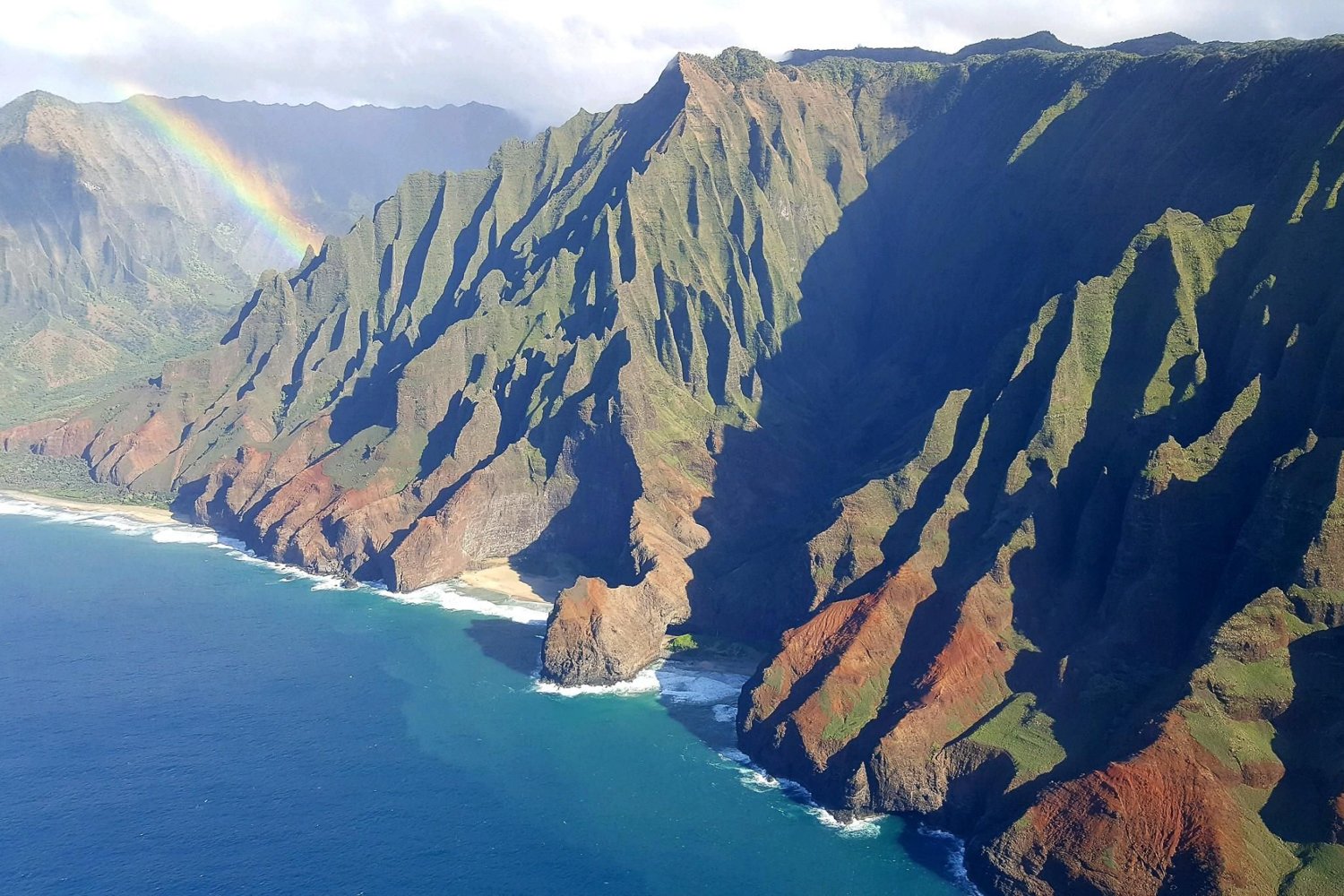
Kauaʻi is the island of sea cliffs and canyons: the Nā Pali coast, Waimea Canyon, the North Shore around Hanalei. Lonely Planet sends hikers here, and in a normal year the Kalalau Trail is open to them. This is not a normal year. As of early October 2026, every Kauaʻi state park except part of Wailua River was closed after Hurricane Lowell, and the Nā Pali boats were reported not running. Helicopters and the fixed-wing air tour from Līhuʻe were flying on limited schedules, so for now the air is the way to see Nā Pali.
Read the State Parks notices before you build a day around a trail. The Kauaʻi page leads with what is running, and each tour’s calendar shows the dates it actually has.
Lānaʻi
Lānaʻi is the smallest of the six islands you can visit: one town, Lānaʻi City, and 3,367 residents at the 2020 Census. Larry Ellison bought roughly 97 to 98 percent of it in 2012, and nearly all overnight visitors stay at its two Four Seasons resorts, one of which, Sensei, takes only guests aged 16 and over.
Getting there is simple. The passenger ferry sails from Māʻalaea on Maui to Mānele Harbor three times a day, about 1 hour 10 minutes each way, at an adult fare of $66 one way in October 2026, and Hulopoʻe Bay is a 10- to 15-minute walk from the harbor. The sights on the north side need a four-wheel drive, and there is no public transit. Stay a night or two, or see it from the water: the Lānaʻi page lists snorkel boats that leave from Maui.
Molokaʻi
Molokaʻi has the highest share of Native Hawaiian residents of the six visitable islands, 65.1 percent alone or in part at the 2020 Census. Lonely Planet calls it the island for “accessing traditional Hawaiʻi” and adds that it “doesn’t really cater to visitors”. The island’s 2026–2028 tourism plan, approved by the state this year, is more specific. It records that residents want tourism to stay smaller-scale, with visitors who are “prepared and respectful”, and it calls for “guided access where it is needed”. Hālawa Valley, for one, is entered only on the family-run cultural hike.
It is fly-in only. The ferry from Maui stopped in 2016; Mokulele flies in from Honolulu and Kahului, and Lānaʻi Air from Honolulu. Hotel Molokaʻi is open, Molokaʻi Ranch’s lodge has been shut since 2008, no beach has lifeguards, and no visitor tours are running to Kalaupapa. The Molokaʻi page covers getting there, what the community asks, and the helicopter flights from Maui that cross to its north-shore sea cliffs, among the highest in the world.
Early October 2026: what the storms changed
As of early October 2026, after a heavy storm season, the islands are not equally open. On Kauaʻi, the State Parks notice of 5 October listed every park closed except part of Wailua River, including Hāʻena and Kēʻē Beach, the Kalalau Trail, Waimea Canyon, Kōkeʻe and Polihale; Kōkeʻe Road and all camping were closed, the Hāʻena shuttle was suspended and Nā Pali boats from storm-damaged Port Allen were reported not running in late September (Holo Holo Charters cancelled through 10 October); the helicopters and air tours flew on limited schedules. On Hawaiʻi Island, Kīlauea was still erupting inside its closed summit crater without fountaining, the Hōlei Sea Arch on Chain of Craters Road collapsed between 23 and 27 September, and the Waipiʻo Valley road stayed closed to visitors under an emergency rule that runs to 1 November, with the lookout at the rim open. On Maui, Lahaina is being rebuilt: Front Street reopened to traffic on 1 August, the small-boat harbor is partly open with full operations expected by the end of 2027, and the Hawaiʻi Tourism Authority asks visitors to honor “the community’s healing by respecting all posted signage, avoiding restricted areas, and refraining from photographing fire-impacted sites”. Hurricane season runs to 30 November, and NOAA forecast an above-normal season for 2026. Check the State Parks notices and each tour’s calendar the week you book.
One island or two
Between most islands you fly. Hawaiian Airlines, whose flights have carried Alaska’s AS flight numbers since 22 April 2026, and Southwest connect Honolulu, Kahului, Kona, Hilo and Līhuʻe. Kahului to Honolulu averages 48 minutes, and since 3 October the inter-island check-in cutoff is 50 minutes before departure. Lānaʻi and Molokaʻi are served by the commuter airlines Mokulele and Lānaʻi Air. The one scheduled passenger ferry runs between Maui and Lānaʻi.
In 2025, 1.43 million visitors, about 15 percent, saw more than one island. U.S. News suggests one island on a tight budget, and Condé Nast Traveler passes on advice from Kaʻiulani Blankenfeld of the Fairmont Orchid to focus on one or two islands a trip. Apart from the Pride of America, a week-long cruise from Honolulu, the only islands linked by sea are Maui and Lānaʻi, as a day trip or an overnight. Flights between Kauaʻi and Hawaiʻi Island usually connect in Honolulu. The island-hopping guide works out how many islands fit in a week.
Niʻihau and Kahoʻolawe
Hawaiʻi has eight main islands; the 137 often quoted is a 1969 count of every named island in the archipelago, five Midway islets outside the State included. Two of the eight are closed to visitors, and the tourism authority asks that neither be promoted as a destination.
Niʻihau, 17 miles from Kauaʻi across the Kaulakahi Channel, has belonged to one family since 1864, when Elizabeth Sinclair bought it; her descendants, the Robinsons, own it now. Its community of 84 (2020 Census) speaks Hawaiian as its first language. The nickname “the Forbidden Island” dates from a 1952 polio epidemic, when nobody could come ashore without a doctor’s certificate and a two-week quarantine. You cannot land or visit the village on your own; the boat trip from Port Allen on Kauaʻi snorkels off Lehua, the islet off its north shore, and does not land. The Niʻihau page has that boat and its post-storm status.
Kahoʻolawe, about 7 miles southwest of Maui, was a U.S. Navy bombing range from 1941 until 1990. The deed went back to the State on 7 May 1994, but a quarter of the island and all of its surrounding waters were never cleared of ordnance, and only volunteer and cultural access trips go ashore. You can see it from South Maui and from the Lānaʻi ferry. The Kahoʻolawe guide tells its history.
Guides for the next decision
The common matchups have their own pages: Maui or Kauaʻi, Maui or Oʻahu and the Big Island or Maui. The best time to visit goes month by month and island by island. The cheapest island sets out room rates, daily spending and the lodging taxes, the families guide checks each tour’s age and weight limits, and the islands map shows where all eight sit and how they connect.
Choosing a Hawaiian Island: The Questions People Ask
What people type before they pick an island, answered in the first sentence, with the sources in the sentences after.
Oʻahu or Maui, and the guides do not agree on which. Condé Nast Traveler (October 2025) sends first-timers to Oʻahu, and U.S. News's 2025 ranking calls Oʻahu “the best jumping-off point for first-time visitors”, though an older U.S. News tips page says Maui. The state's visitor site says there are no wrong answers. DBEDT's figures show where first-timers go: 35.4 percent of Oʻahu's 2025 visitors were on their first trip to Hawaiʻi, against 27.3 percent of Maui's. Oʻahu gives you Honolulu, Waikīkī and Pearl Harbor and the lowest average hotel rate of the four big islands ($284 a night in 2025); Maui gives you the Road to Hāna and Haleakalā at a higher daily cost ($305 per visitor per day against Oʻahu's $238). Start with Oʻahu or Maui, or read the two compared.
Oʻahu if you want a city, history and a lower daily cost; Maui if you want scenery, long drives and fewer people around you. In 2025 Oʻahu's visitors spent $238 per person per day and Maui's $305 (DBEDT), and hotels averaged $284 a night on Oʻahu against $537 across Maui County. On an average day Oʻahu held 107,479 visitors and Maui 54,500. Oʻahu has Honolulu, Waikīkī, Pearl Harbor and the North Shore's winter surf, plus traffic: INRIX ranked Honolulu the 20th most congested U.S. urban area in 2025. Maui has the Road to Hāna, sunrise on Haleakalā (a $1 vehicle reservation on top of the $30 park entrance fee, as of October 2026) and humpback whales from November to April. Lonely Planet, Condé Nast Traveler and U.S. News all send couples to Maui. Maui or Oʻahu, trip by trip.
In a normal year Lonely Planet sorts them as Kauaʻi for hiking and waterfalls and Maui for romance and scenic drives; in October 2026 Kauaʻi also comes with a storm caveat. After Hurricane Lowell, the State Parks notice of 5 October listed every Kauaʻi state park closed except part of Wailua River, including Hāʻena, the Kalalau Trail and Waimea Canyon, with Kōkeʻe Road shut; the air tours from Līhuʻe were flying on limited schedules. Maui's state parks had all reopened except Polipoli. Kauaʻi is smaller and less visited (1.41 million visitors in 2025 against Maui's 2.53 million) and slightly cheaper per day ($282 per person against $305). Read Maui or Kauaʻi, compared, and check the State Parks notices before you plan a day around a trail.
By the state's spending figures, Molokaʻi: its visitors averaged $191 per person per day in 2025, against $238 on Oʻahu and $629 on Lānaʻi, the most expensive. For most travelers the practical answer is Oʻahu, which Lonely Planet names for budget trips because of its public transit and range of room prices, and whose hotels averaged $284 a night in 2025, the lowest of the islands the state reports (Waikīkī's averaged $268). About three-quarters of Molokaʻi's places to stay are vacation rentals. Every island adds the same lodging taxes in 2026: the state's 11 percent transient accommodations tax (the Green Fee raised it from 10.25 percent), a 3 percent county tax and up to 4.712 percent general excise tax, about 18.7 percent on top of a room rate. The cheapest-island guide goes island by island.
No official figure answers this, but $1,000 is well under what visitors actually spent in 2025. The state's average was $260 per visitor per day, about $1,820 over seven days (DBEDT). $1,000 a week works out to about $143 a day, below the 2025 average on every island, including the cheapest, Molokaʻi, at $191. Doing it means spending far below those averages: one island, cheap lodging and mostly free sights, such as the Pearl Harbor National Memorial, which charges no entrance fee. Lonely Planet's budget advice is to stay on one island, “especially Oʻahu”. Costs, island by island.
No official figure says, but at the state's 2025 spending averages a week for two comes to about $3,330 on Oʻahu, $4,270 on Maui and $8,810 on Lānaʻi. Those are DBEDT's per-person daily averages ($238, $305 and $629) times seven days times two people. Hawaiʻi Island ($246) and Kauaʻi ($282) fall in between, and Molokaʻi ($191) below. Whether $5,000 also covers your flights depends on where you fly from. The averages hide a wide spread: Waikīkī's hotels averaged $268 a night in 2025 and Wailea's on Maui $758. The cheapest-island guide has room rates and taxes by island.
There is no single best month; pick by what you want to see and do. NOAA says humpback whales are generally seen from November to April, peaking January to March. The National Weather Service describes two seasons, summer from May to October and winter from October to April, with the heaviest rain in winter; winter also brings large surf to north- and west-facing shores, and summer is the south shore's surf season. August and September are the warmest months and February and March the coolest. Hurricane season runs from 1 June to 30 November, and NOAA forecast an above-normal 2026. On cost, Lonely Planet says early and late spring and the fall are cheaper. Month by month and island by island.
The National Weather Service names no single month: most of Hawaiʻi's heavy rain falls in the winter season, October to April, from winter storms. Where you stay matters more than the month. Windward coasts and slopes, facing the northeast trade winds, catch far more cloud and rain, while leeward areas “tend to be sunny and dry”, in the Weather Service's words. Hawaiʻi Island shows the gap: by NOAA's 1991–2020 normals, Hilo's airport averages 120.39 inches of rain a year and Kona's 9.87. Līhuʻe, on Kauaʻi, averages 36.22. The best-time guide goes island by island.
The guides split between Maui and Oʻahu. U.S. News calls Maui “the best island for both couples and families looking for variety”; Condé Nast Traveler picks Oʻahu because it has the most beaches with lifeguards, parking and restrooms, with 42 lifeguard towers on 21 city-supervised beaches. The state's visitor site spreads its family picks across the islands: Hawaiʻi Volcanoes National Park, Oʻahu's historic sites and museums, the Maui Ocean Center and Kauaʻi's Nā Pali boat tours, which were not running after Hurricane Lowell. Check the limits before you promise a child anything: no one under 13 should go above Maunakea's visitor station, and there are no lifeguards at Lānaʻi's Hulopoʻe Beach or on any Molokaʻi beach. The families guide lists each tour's age and weight limits.
Kauaʻi is open to visitors, but as of early October 2026 much of what people go for was still closed after Hurricane Lowell. In mid-September the County encouraged people with upcoming trips to consider another island while Kauaʻi recovered; by October the Hawaiʻi Tourism Authority's page said “Kauaʻi is welcoming visitors, with most accommodations, restaurants, shops, tours, and activities operating as usual”, with some businesses short-staffed. The State Parks notice of 5 October listed every state park closed except part of Wailua River, Kōkeʻe Road and all camping closed, and the Hāʻena shuttle suspended. Nā Pali boats from Port Allen were reported not running in late September, while the air tours from Līhuʻe flew on limited schedules. Hurricane season runs to 30 November. The Kauaʻi page leads with what is running; check the State Parks notices before you go.
Only one: the passenger ferry between Māʻalaea Harbor on Maui and Mānele Harbor on Lānaʻi. Expeditions runs three round trips a day, about 1 hour 10 minutes each way, and reservations are required; the adult base fare was $66 one way in October 2026. It has sailed from Māʻalaea, not Lahaina, since the 2023 fire, so ignore older timetables. There has been no Maui–Molokaʻi ferry since 2016, and Maui County's earliest Molokaʻi service is 2029; the county also plans to take over the Lānaʻi route in mid-2027. Every other hop is a flight: Hawaiian and Southwest between the main airports, Mokulele and Lānaʻi Air to Lānaʻi and Molokaʻi. The island-hopping guide has the routes.
Niʻihau and Kahoʻolawe, the two main islands you cannot visit. Niʻihau has been owned by one family since 1864 and had 84 residents at the 2020 Census; its nickname, the Forbidden Island, dates from a 1952 polio epidemic, when no one could come ashore without a doctor's certificate and a two-week quarantine. The boat trips from Port Allen on Kauaʻi snorkel off nearby Lehua and do not land. Kahoʻolawe was a U.S. Navy bombing range from 1941 to 1990 and went back to the State in 1994; a quarter of the island and all its surrounding waters were never cleared of ordnance, and only volunteer and cultural trips go ashore. The state's tourism authority asks that neither island be promoted as a destination. Niʻihau and Kahoʻolawe each have a page here.
Larry Ellison, who bought Lānaʻi's island holdings in 2012; the share is roughly 97 to 98 percent, depending on the source. The landowner's own 2026 filing with the state Land Use Commission says Castle & Cooke, the company Ellison bought from, had acquired “more than 98 percent of the island”, while the Lānaʻi Culture & Heritage Center says Ellison bought “about 97 percent”. The rest belongs to the State, the County and private homeowners. Pūlama Lānaʻi manages the holdings. The island was a Dole pineapple plantation from 1922 until the last harvest in 1992, and today nearly all overnight visitors stay at its two Four Seasons resorts. Visiting Lānaʻi.
Eight main islands, six of which you can visit. The eight are Hawaiʻi Island, Maui, Oʻahu, Kauaʻi, Molokaʻi, Lānaʻi, Niʻihau and Kahoʻolawe; seven are inhabited, and Kahoʻolawe is not. The 137 often quoted is the number of named islands in the whole Hawaiian archipelago, from a 1969 state report, and five of those, the Midway islets, are not part of the State of Hawaiʻi. The six open to visitors, in the tourism authority's list, are Kauaʻi, Oʻahu, Molokaʻi, Lānaʻi, Maui and the island of Hawaiʻi; Niʻihau is private and Kahoʻolawe has no public access. The islands map shows where each sits.
Still have questions? Email us at info@besthawaiianisland.com
Every Tour on Every Island
Every tour listed here has its own page with the price, rating and review count, and the harbor, airport, heliport or hotel pickup it starts from.